
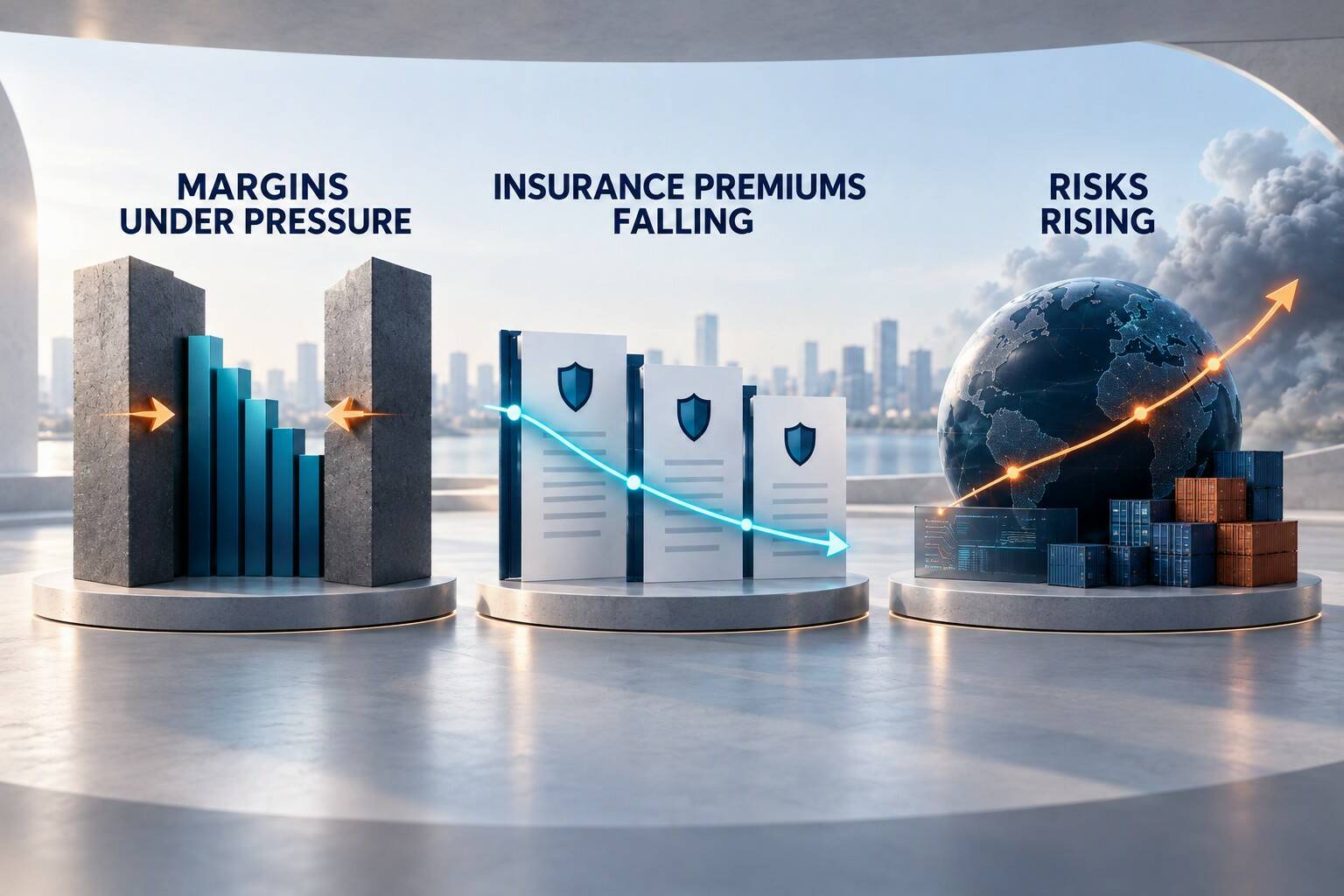
With risks rising, margins under pressure and the insurance market softening, renewing programmes unchanged is no longer a strategy.
Businesses devote considerable energy to challenging their costs. Procurement, property, energy, IT, consultancy, logistics: in an economic environment of weak growth and squeezed margins, virtually no area of expenditure escapes scrutiny for long. Yet one still too often receives special treatment: insurance.
Because it is technical. Because relationships with brokers and insurers are built over time. Because an international programme is complicated to rebuild. And sometimes simply because “it works”. In the current environment, this relative inertia is becoming difficult to defend.
And 2027 could well be one of the best opportunities in years to put an end to it.
An exceptional convergence
Three developments are coming together:
1- The first is economic. Businesses need to protect their margins and review their operating costs. Insurance should be subject to the same scrutiny as other significant expenditure. Not through indiscriminate cost-cutting, as we shall discuss, but by asking a simple question: are we paying the right price for the protection we actually need?
2- The second concerns the insurance market. After the hard market years, capacity is returning across many lines and competition is once again working in policyholders’ favour. AMRAE’s 2026 study is particularly illuminating. In property insurance, reductions can reach 10–15% for well-managed risks. In goods in transit, they generally range from 5–10% and can reach 20–30% on certain attractive programmes put out to tender. In liability insurance, observed reductions are 5–10% and can sometimes reach 30%. And in cyber, they still average 15–30%. One finding in the study should particularly catch the attention of finance directors and risk managers: cyber programmes that have not been put out to tender for two or three years can still secure significant reductions. In other words, the length of time a programme has been in place is itself becoming an issue.
3– But a third development makes the equation much more interesting: while the insurance market is easing, the world is not, and risks are increasing.
Cheaper insurance for more complex risks
Geopolitical fragmentation, wars and sanctions, supply chain disruption, climate change, social tensions, riots, cyberattacks, artificial intelligence, changing liabilities, technological dependencies… In just a few years, many businesses’ risk profiles have changed profoundly.
The AMRAE study shows, for example, that insurers are maintaining geographical restrictions relating to Russia, Ukraine and Belarus across several lines, while the Middle East is raising new questions about exclusions, sublimits and war risks. In political risk and political violence insurance, geopolitical tensions could lead to premium increases of 10–40%, depending on exposure and claims experience.
Climate change is also creating new blind spots. The study highlights, in particular, the gap between traditional property cover and the economic consequences of phenomena such as value chain disruption, heatwaves or water stress, which can generate business interruption losses without prior physical damage.
And artificial intelligence is opening a new chapter. It increases the risks of phishing, deepfakes, document fraud, identity theft, errors in automated decision-making, and infringements of intellectual property or data rights. Yet the question is not necessarily whether to take out “AI insurance” tomorrow, but whether existing cover fits together properly across cyber, crime, public liability, professional indemnity, product liability and directors’ and officers’ liability.
That, then, is the paradox of 2027: risk is increasing and changing just as the market is giving businesses renewed negotiating leverage. This is precisely what creates the opportunity.
The point is certainly not to negotiate 10% off the premium
That would, in fact, miss the point. A meaningful review starts with four questions:
1- Which scenarios could now materially affect the balance sheet or profit and loss account?
2- What proportion of these exposures do we want to retain, prevent or transfer?
3- Would our current policies actually respond to these scenarios?
4- Is the price we pay consistent with what the market can offer today?
Only then does the premium come into the picture. On this point, AMRAE’s message is particularly apt: a cheaper market does not necessarily provide better protection. Prices can fall even as exclusions, sublimits or difficulties in how policies fit together increase. The real question is therefore not simply “how much does my insurance cost?”, but “what will it actually pay out when I need it?”
This is a fundamental distinction. Reducing the cost of risk is not the same as reducing the price of insurance.
Why simply asking your broker to “test the market” is not enough
This is where we need to be willing to ask a sometimes uncomfortable question.
A long-standing broker may well be doing an excellent job. They know the business, its claims history, its insurers, its risks and its constraints. That knowledge has real value.
But the firm that designed, negotiated and placed a programme cannot also be its sole judge of competitiveness.
The risk is a fairly natural one: improving what is already there rather than questioning how it was built. Repackaging the old as new. Yet if the risk profile has changed, new insurers have entered the market, capacity has evolved and new solutions are available, optimisation and redesign are not the same thing.
There is also an economic issue that is rarely discussed openly: how the broker is remunerated. Where remuneration relies wholly or partly on commissions proportional to premiums, there is an objective conflict between the client’s aim of substantially reducing insurance costs and the intermediary’s business model. This is not about questioning anyone’s good faith. It is simply about applying to insurance the governance principles that the business applies everywhere else: a potential conflict of interest should not be denied; it should be managed.
The right approach: put ideas to the test before putting prices out to tender
The most effective approach is therefore not a routine tender for brokerage services. It is a tender for the design of the main insurance programmes. The distinction is crucial.
The aim is not to ask several brokers to quote for exactly the same structure. That would merely compare their ability to buy the same product. Instead, they should be asked to work from the same risk map, claims data and exposure scenarios. Each bidder should be able to propose:
- The programme structure they recommend;
- The risks they consider insufficiently or unnecessarily transferred;
- Any missing cover or cover that has become obsolete;
- Appropriate limits and sublimits;
- Deductible and retention levels;
- The trade-offs between insurance, self-insurance and, where appropriate, a captive;
- How the policies fit together;
- The capacity they believe they can realistically secure;
- Available market innovations;
- And, finally, the target budget they consider achievable.
Different insurers can then be approached on the basis of the selected structures.
This is how businesses discover not only whether they are paying too much, but above all whether they are still buying the right insurance product.
Above all, do not turn insurance into a cost-cutting exercise
The opposite mistake would be to see the soft market merely as an opportunity for procurement to impose a budget cut.
Remember: an insurance policy is not an ordinary expense. Its purpose is to protect the business’s balance sheet and profit and loss account against certain severe disruption scenarios.
A 15% saving becomes insignificant if, in return, an exclusion, a sublimit or poorly coordinated policies leave tens of millions of euros on the balance sheet following a major loss.
The AMRAE study specifically encourages businesses to look beyond the insurance budget and think in terms of the total cost of risk, including premiums, deductibles, uninsured losses, business interruption, prevention and the cost of returning to normal.
This exercise must therefore involve risk management, finance, operational management and procurement, each playing their part.
What about loyalty?
Then there is the traditional argument: “In insurance, loyalty always pays off in the end.” Perhaps.
But a long-standing relationship only has value if it delivers something: a better understanding of the risk, committed capacity, quality claims handling, stability when the market turns, service quality or better financial terms. Loyalty must be measurable. Otherwise, it is simply inertia.
And believing that an insurer will apply market terms because a client has remained loyal for fifteen years sometimes follows the same logic as certain political promises: they only truly bind those who choose to believe them.
2027 : a window that will not stay open forever
Of course, not all segments are seeing reductions. Motor remains subject to inflationary pressure, construction remains challenging for certain risks, and personal insurance is facing significant upward pressure on premiums.
But that is precisely why businesses need to proceed programme by programme, rather than seek a uniform reduction.
The market is cyclical. The study itself notes that the current easing remains fragile: a major climate event, a systemic cyberattack, civil unrest or pressure on reinsurance could quickly shift the balance.
There is therefore probably a window spanning a few renewal cycles in which many businesses can simultaneously reduce costs, improve cover, rebuild capacity and adapt their programmes to the risks they will face tomorrow.
For those that have rigorously reviewed their programmes over the past two or three years, the priority is probably to continue that work.
For the rest, after five, seven or ten years of renewing broadly the same structures with the same partners, doing nothing is becoming much harder to justify.
In the current environment, for a finance or risk function, failing to check periodically that several million euros in premiums are actually buying the best protection available in the market is beginning to look less like loyalty and more like a failure of management.
2027 gives us precisely the opportunity to find out. It would be a shame to wait until the next hard market to discover what we could have secured today…